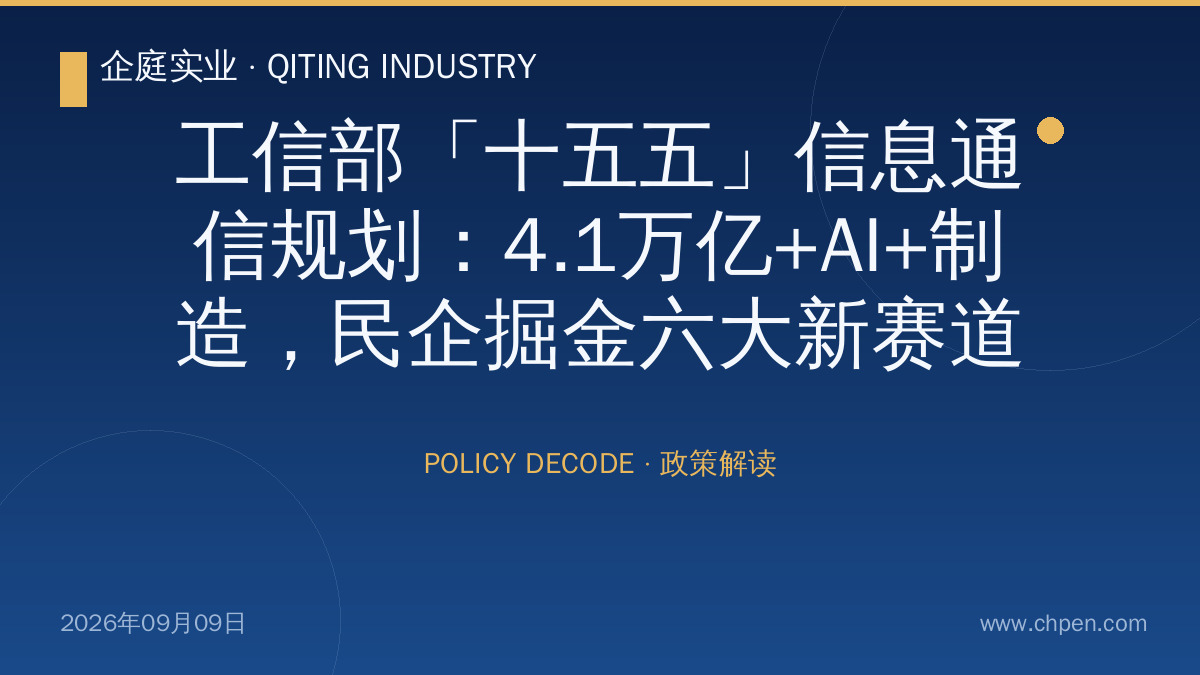
On August 12, 2026, China's Ministry of Industry and Information Technology (MIIT) released the "15th Five-Year Plan for the Development of the Information and Communication Industry" (Document No. 188 [2026]), outlining a clear roadmap for the sector from 2026 to 2030. The plan sets quantitative targets including industry revenue of 4.1 trillion yuan, cumulative investment in information infrastructure of 3.8 trillion yuan, and intelligent computing power of 9800 EFLOPS by 2030. It also outlines 26 key tasks. For private enterprises and innovators, this document not only signals policy direction but also reveals vast business opportunities in digital infrastructure, artificial intelligence, satellite communications, and cybersecurity.
**I. Planning Background: Anchoring New Industrialization**
The "15th Five-Year" period is critical for China's basic realization of new industrialization. The plan emphasizes high-quality development, adhering to principles of people-centeredness, reform and innovation, serving the real economy, and open cooperation. It focuses on five priorities: strengthening foundations, improving people's livelihoods, optimizing governance, preventing risks, and promoting openness. This signals that the ICT industry will not only grow itself but also deeply empower the real economy, especially manufacturing digital transformation.
**II. 13 Key Indicators: Clear Market Space**
The plan sets 13 key indicators for 2030. Key economic metrics include: industry revenue of 4.1 trillion yuan, cumulative investment in information infrastructure of 3.8 trillion yuan, and average annual growth of telecom business volume of 7%. In infrastructure, the plan targets 50 5G (including 5G-A) base stations per 10,000 people, construction of 500,000 new 5G-A base stations, 5G user penetration of 95%, and over 100 million gigabit broadband users. In computing, intelligent computing power is targeted to reach 9800 EFLOPS, with improved energy efficiency for new large-scale facilities. The plan also emphasizes increased R&D investment, reduced carbon emissions per unit of telecom business, and promotion of satellite direct-to-phone applications.
**III. 26 Key Tasks: Comprehensive Layout**
The plan deploys 26 key tasks across six areas, supported by 13 special projects.
1. **Moderately advanced deployment of information infrastructure**: Upgrading network facilities, building computing infrastructure, developing space networks, and promoting intelligent, green, and integrated infrastructure. Specific measures include accelerating the national integrated computing network, promoting "5G+BeiDou" integration, and exploring space computing.
2. **Cultivating the ICT industry system**: Emphasizing core technology breakthroughs, strengthening supply chain resilience, improving standards, and promoting integrated innovation among large and small enterprises. Notably, it plans to launch 6G commercial use in due course and conduct systematic research on 6G key technologies.
3. **Systematically optimizing industry governance**: This involves regulatory reform and business environment improvement, including orderly promotion of new technology applications like eSIM and network-free communication.
4. **Enhancing network and data security**: Building an industry anti-fraud laboratory and strengthening security protection.
5. **Expanding the breadth and depth of integrated applications**: Focusing on supporting "AI + Manufacturing" and promoting digital applications in industry, agriculture, and services.
6. **Improving globalization**: Expanding international internet bandwidth, accelerating global satellite communication coverage, and steadily opening up the telecom sector.
**IV. Opportunities for Private Enterprises**
Several deployments directly benefit private companies:
- **5G-A and communication equipment**: Building 500,000 new 5G-A base stations will drive demand for equipment, modules, and antennas, offering opportunities for private suppliers.
- **Computing power and data centers**: The 9800 EFLOPS target implies massive construction of intelligent computing centers, benefiting private IDC operators, liquid cooling solution providers, and AI chip startups.
- **AI + Manufacturing**: The plan's support for this area creates project opportunities for digital transformation service providers and industrial AI developers.
- **Satellite communications and BeiDou**: Promoting satellite direct-to-phone and global coverage boosts commercial space and satellite application firms.
- **Cybersecurity and anti-fraud**: Building anti-fraud labs and strengthening data security will drive demand for private security companies.
- **6G and frontier technologies**: Encouraging collaborative research and development allows private research institutions and innovators to participate in standardization.
**V. Implications for Private Companies**
Private enterprises should: First, align with policy rhythms and find "specialized and sophisticated" positions in new infrastructure like 5G-A, computing networks, and satellite internet. Second, deepen "AI + Manufacturing" scenarios using data advantages to create replicable solutions. Third, actively engage in governance innovation, such as preparing for eSIM and network-free communication applications.
The plan opens vast development space for private enterprises. Those who can quickly translate policy dividends into market competitiveness will seize the lead in the digital economy wave over the next five years.
Sources:
- MIIT policy document: https://wap.miit.gov.cn/zwgk/zcwj/wjfb/tz/art/2026/art_456511e63be14508aa5b0d113af559fe.html
- Xinhua News: https://www.news.cn/tech/20260908/1b341406b10448c5b50a170813a8fad3/c.html
- CNR News: https://www.cnr.cn/china/news/20260908/t20260908_527807752.shtml
China's 15th Five-Year ICT Plan Targets 4.1 Trillion Yuan Market, AI+Manufacturing Push Opens New Avenues for Private Firms
作者:企庭AI研究院160 阅读